

Contextual Policies
Policies control what your Omnigent can and cannot do. They intercept every action (tool calls, LLM requests, file operations) and decide in real time whether to allow, ask for approval, or deny.
Why “contextual”?
Most agent frameworks offer static rules: allow this tool, deny that one. Omnigent policies are different. They are stateful and dynamic: each policy maintains its own state across the entire session and makes decisions based on what has happened so far.
This is what enables policies that static systems simply cannot express:
- Cost budgets. Track cumulative LLM spend across every turn. Warn at $3, block expensive models at $5. The policy remembers what you've spent.
- Rate limiting. Count tool calls over time and deny after a threshold. The count persists across the session, not per-request.
- Risk scoring. Accumulate a risk score from sensitive operations (accessing credentials, modifying production data). Escalate to human approval once the score crosses a threshold.
- Model routing. Classify tasks as trivial or complex and redirect trivial ones away from expensive models, based on conversation context.
Every policy evaluation receives the full session context: cumulative cost, tool call history, data classification labels, and custom state you define. This makes Omnigent's policy system fundamentally more powerful than the static security controls built into individual coding agents.
What you can enforce
For example: cap spending, require approval before destructive actions, restrict access to repos or services, block PII, or route models. See Builtin Policies for the full list.
How policies work
Each policy returns one of three decisions:
| Decision | What happens |
|---|---|
| ALLOW | The action proceeds. |
| ASK | The action pauses until the user approves or rejects it. |
| DENY | The action is blocked with an error message. |
If any policy returns a DENY decision, the action is blocked; otherwise, if any policy returns an ASK decision, the action waits for your approval; otherwise, it proceeds. Post-tool policies cannot undo an action that has already happened.
Available policies
Omnigent provides builtin policies for common guardrails (cost budgets, approval gates, access controls, PII blocking, model routing). You can also write your own custom policies in Python and register them on the server to make them available:
# server config (config.yaml)
policy_modules:
  - myorg.policies
Start the server with that file:
omnigent server -c config.yamlThe -c flag is short for --config. This makes your custom policies
discoverable alongside the builtins. See
Custom Policies for how to write and register them.
Three levels
To apply a policy, you pick one (builtin or custom) and add it at one of three levels. Each level has a different scope and priority:
| Level | Who | Scope | How to add | Priority |
|---|---|---|---|---|
| Session | End user | Current session only, not persistent | Ask your Omnigent, or use the UI settings panel | First |
| Omnigent config | Developer | Every session using this Omnigent | policies block in the Omnigent YAML | Second |
| Server-wide | Admin | Every agent and session on the server | Settings page, server config YAML, or REST API | Last |
An admin can set a company-wide cost cap, a developer can restrict which repos the Omnigent writes to, and an end user can add extra approval gates. All three levels are enforced simultaneously.
Adding a policy
Session level: ask your Omnigent (recommended)
The easiest way to add a policy is to ask your Omnigent directly. Describe what you want in plain language:
You: Add a policy that asks me before running any shell commands.

You: Limit this session to $5 of LLM spend.

You: Block access to all GitHub repos except myorg/frontend.
Your Omnigent picks the right policy from the available registry (both builtin and any custom policies registered on the server), configures the parameters, and asks for your approval. Once you approve, the policy takes effect immediately on the next turn of the current session.
You can also browse and toggle policies from the settings panel in the web UI without typing anything in chat.
Omnigent config level: declare in YAML
For policies that should always apply, declare them in the policies block of
your Omnigent config. These take effect every time the Omnigent starts.
policies:
  approve_file_ops:
    type: function
    handler: omnigent.policies.builtins.safety.ask_on_os_tools
  rate_limit:
    type: function
    handler: omnigent.policies.builtins.safety.max_tool_calls_per_session
    factory_params:
      limit: 50
Here rate_limit caps the total number of tool calls a single session can make
(50 in this example), a guard against runaway agent loops and surprise cost. Once the cap
is reached, further tool calls are denied for the rest of the session.
Policies without parameters use just handler. Configurable policies add
factory_params. Multiple policies are evaluated in the order declared.
Server-wide level: server config
Server-wide policies apply to every session on your deployed server. Add them
to a config file and pass it with -c (--config is the long form):
policies:
  session_cost_guard:
    type: function
    function:
      path: omnigent.policies.builtins.cost.cost_budget
      arguments:
        ask_thresholds_usd: [1.0]
        max_cost_usd: 5.0
  user_daily_cost_guard:
    type: function
    function:
      path: omnigent.policies.builtins.cost.user_daily_cost_budget
      arguments:
        ask_thresholds_usd: [10.0, 25.0]
        max_cost_usd: 50.0
omnigent server -c config.yamlServer-wide policies use the function: {path, arguments} format (not
handler / factory_params). Restart the server after editing.
Admins can also manage server-wide policies without touching config files from
the Settings page at /settings/policies. Changes take effect immediately
without a server restart.
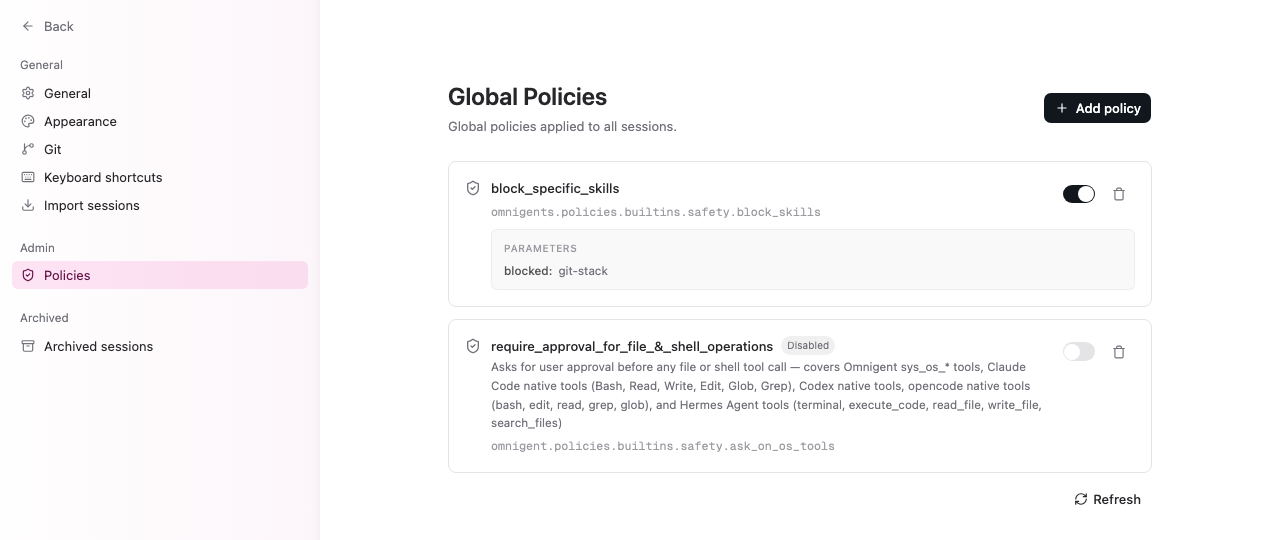
Server-wide policies can also be managed at runtime via the REST API:
| Method | Endpoint | Description |
|---|---|---|
POST | /v1/policies | Create a policy |
GET | /v1/policies | List all policies |
PATCH | /v1/policies/{id} | Update a policy |
DELETE | /v1/policies/{id} | Remove a policy |